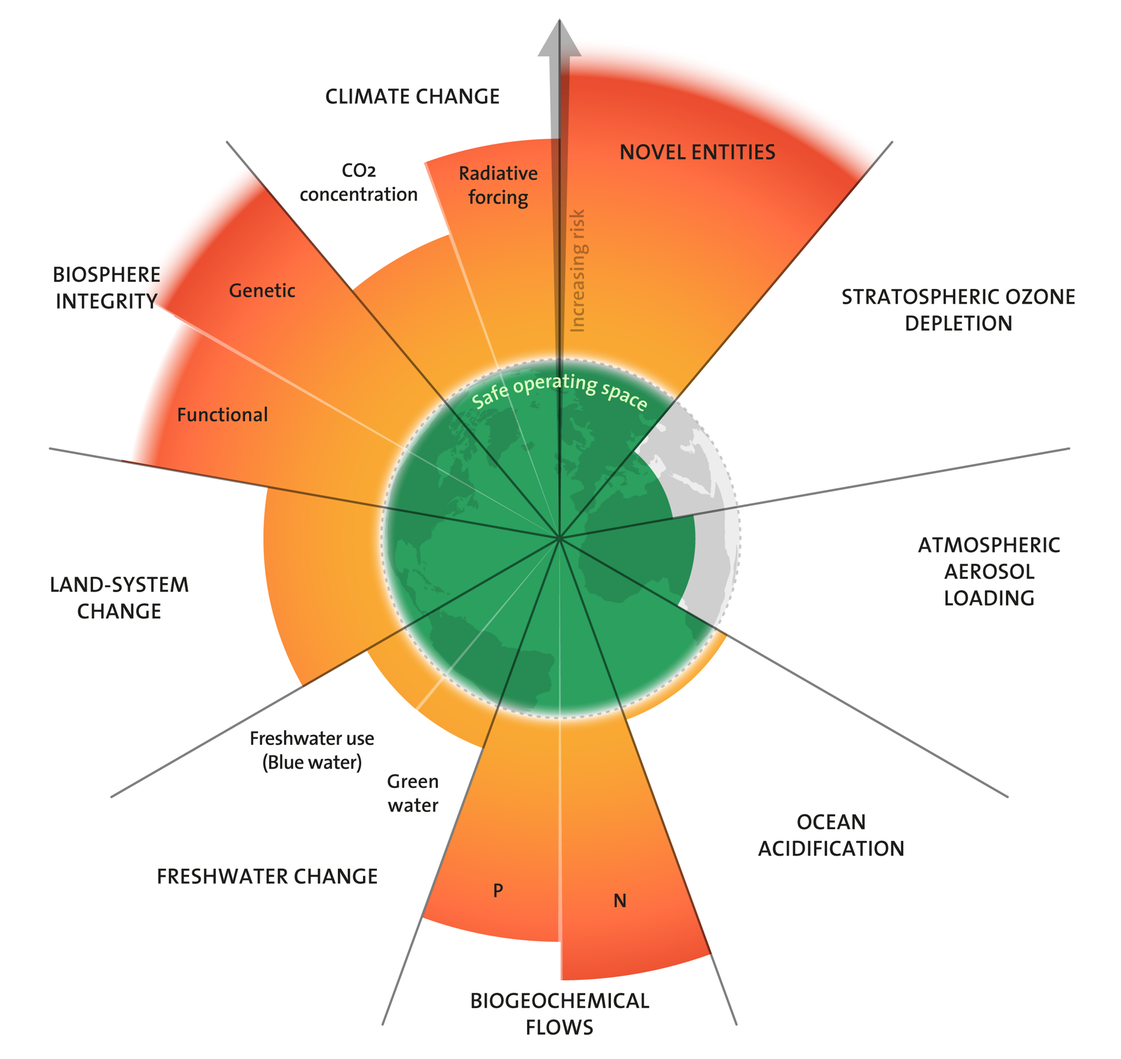
This post discusses the recent Planetary Health Check 2026 [1] from a vegan point of view. The report, published in September, gives the most up-to-date assessments of what are known as the Planetary Boundaries.
Boundaries come in many forms. They can define the area of a piece of land, or the range of acceptable behaviours in a relationship. A common purpose is to mark out an area of safety beyond which it is dangerous to go.
With this in mind, scientists have identified nine Planetary Boundaries. In other words, a safe operating space, within which humanity and human civilisation must live in order to thrive, and even to survive.
The nine boundaries are named below:
- Climate Change
- Change in Biosphere Integrity
- Land System Change
- Freshwater Change
- Modification of Biogeochemical Flows
- Ocean Acidification
- Increase in Atmospheric Aerosol Loading
- Stratospheric Ozone Depletion
- Introduction of Novel Entities
It is important to notice that these boundaries are not set by scientists but are a consequence of the Laws of Physics and the world in which we live.
If humanity crosses these boundaries it has to turn back or face the consequences. It cannot negotiate new terms and conditions.
The planetary boundaries were first described in 2009. At the time three of the boundaries were assessed as having been crossed.
The presence of more than one boundary shows that the world is not only facing a well documented climate crisis, but other crises such as biodiversity, ocean and pollution crises. Some have called this a Polycrisis. Many of these problems are interconnected.
This year, according to the latest Planetary Health Check, seven of the nine Planetary Boundaries are now at their highest recorded levels of transgression. [2]
It is almost impossible to exaggerate the danger we find ourselves in.
What are the boundaries and how far have we stepped over them?
The chart below shows the nine boundaries. Seven boundaries, coloured orange, have been crossed by varying amounts.
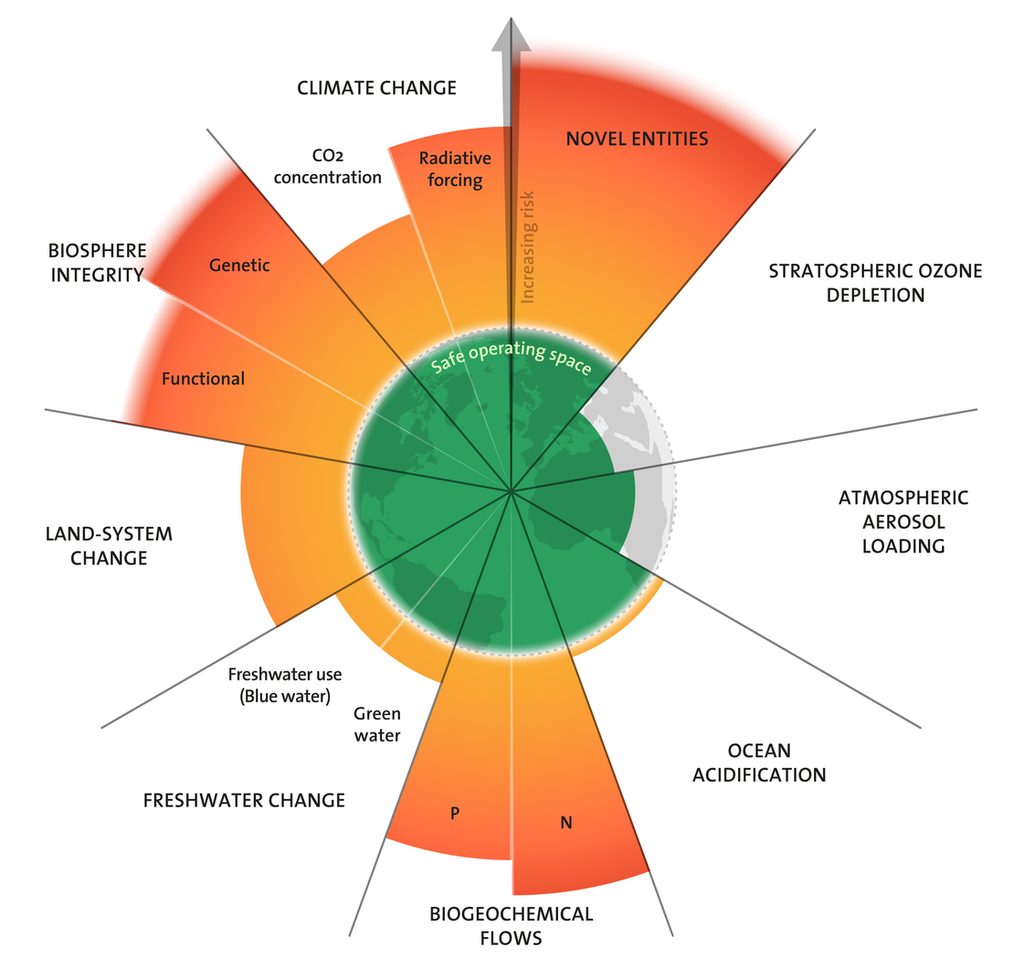
Below are descriptions of each boundary taken from the report, followed by my comments discussing how taking up plant based diets can help return us to a “Safe Operating Space”
The reason for highlighting these in Vegan Pieces is because diet makes a significant contribution to staying within most of the boundaries.
We can sometimes look at these problems and think, “What are “they“ doing about this?” By understanding the effect of dietary choices we can see that, “Here is something “I” can do”.
1 Climate Change
The alteration of Earth’s radiative balance, for example by accumulating greenhouse gases in the atmosphere, affects global temperatures and climate patterns.
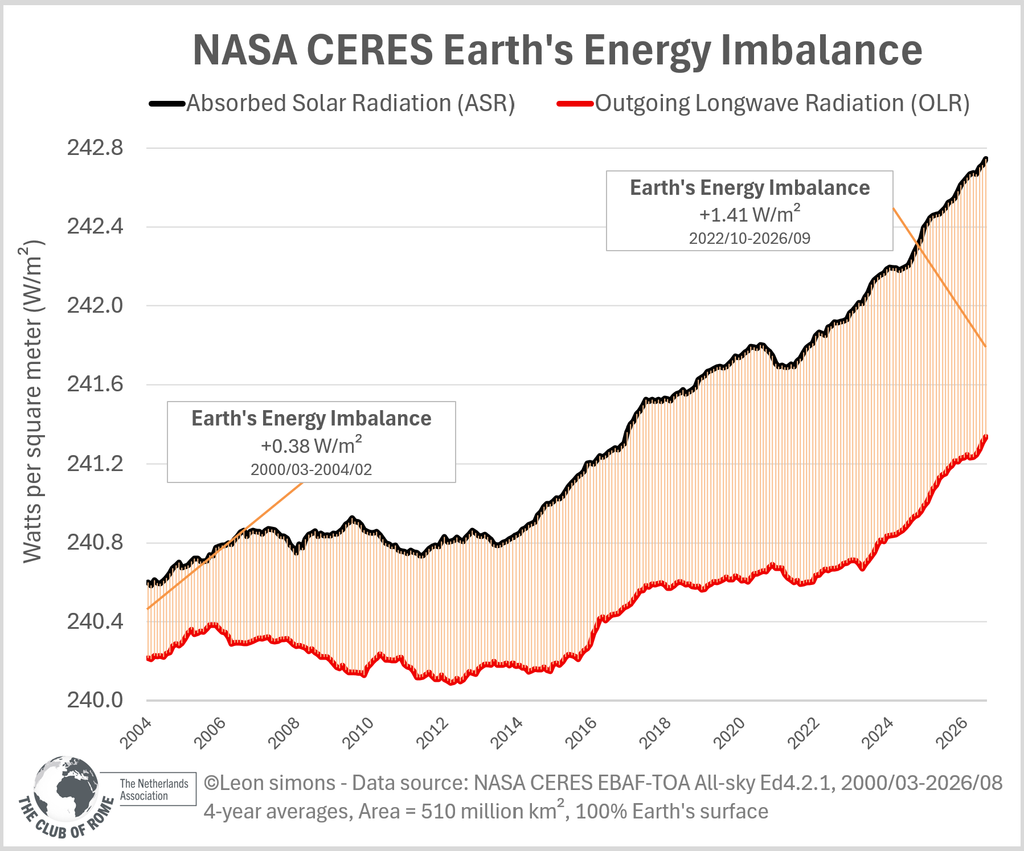
The imbalance between the incoming solar radiation and the outgoing infrared radiation, shown in the chart below, has increased from an average of about 0.38 Watts per square meter in 2004 to 1.4 Watts in 2026, an increase of 270% in 20 years. It is concerning to notice that incoming solar radiation is also increasing because of changes to cloud reflection, reduction in atmospheric aerosols and reduced surface reflectivity due to loss of polar ice.
If 1.4 Watts per square meter across the earth is difficult to envisage, then imagine one million Hiroshima bombs per day. That’s how fast the planet is heating today.
Livestock farming is a major contribution to greenhouse gases that are trapping heat and warning the planet. Methane is emitted by fermentation in the guts of cattle, and by the management of manure. Carbon dioxide is emitted from land cleared and burned to make way for livestock and feed crops. Nitrous Oxide is emitted from manure and the production and use of nitrogen fertilisers for animal feed.For a typical western diet, changing from a meat-inclusive diet to a plant-based diet can reduce food greenhouse gas emissions by 50-70% and a personal carbon footprint by about 15%.
2 Change in Biosphere Integrity
The decline in the diversity, extent, and health of living organisms and ecosystems affects the biosphere’s ability to co-regulate the state of the Planet by impacting the energy balance and chemical cycles on Earth.
Livestock farming is one of the greatest reasons for biodiversity loss through habitat destruction, habitat fragmentation, wildlife displacement and species extinction. It requires vast areas of land which could otherwise be used for forests, wetlands and other eco-systems. Cattle require more land per weight of produced protein than high protein bean and pulse crops.
“Whether human beings survive this century and the next, whether other lifeforms can live alongside us: above all, this depends on the way we eat. We can cut our consumption of everything else close to zero and still drive living systems to collapse, unless we change our diets”. [3]
3 Land System Change
The transformation of natural landscapes, such as through deforestation and urbanization, diminishes ecological functions like carbon sequestration, moisture recycling, and habitats for wildlife, all crucial for Earth system health.
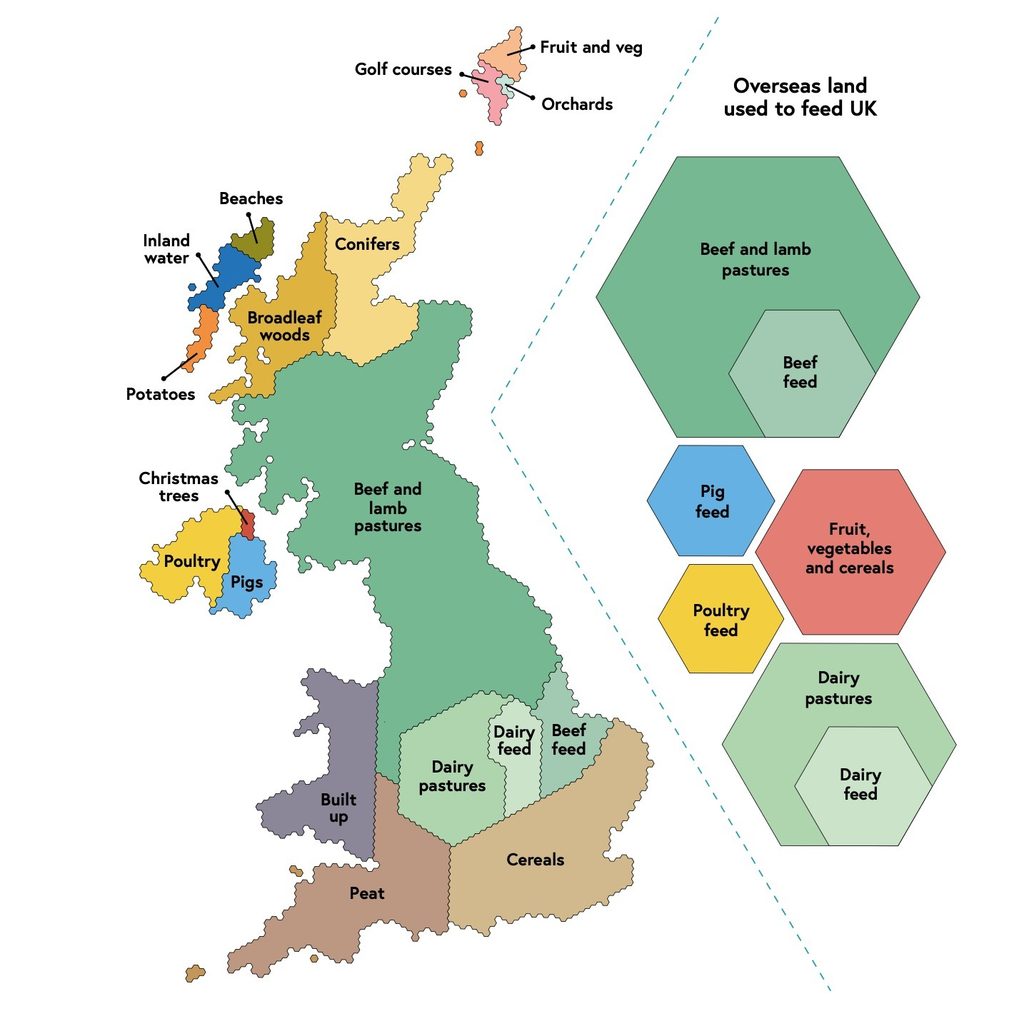
Livestock farming is a major cause of deforestation. The UK was largely deforested centuries ago. Now 84% of the Utilised Agricultural Area is used to feed livestock, rather than for direct human consumption [4]. Taking up plant based diets can make it possible to reverse this land system change.
4 Freshwater Change
The alteration of freshwater cycles, including rivers and soil moisture, leads to impacts on natural functions such as carbon sequestration and biodiversity, and potential shifts in future precipitation levels.
Large volumes of water are used to grow maize, alfalfa, soy and other feed crops. Although Almond Milk is often criticised for its water footprint which is greater than than most other plant based milks, it is still 50% lower than the water footprint of dairy milk [5]
“The water footprint of any animal product is larger than the water footprint of crop products with equivalent nutritional value …The unfavorable feed conversion efficiency for animal products is largely responsible for the relatively large water footprint of animal products”. [6]
5 Modification of Biogeochemical Flows
The disruption of natural nutrient cycles, such as nitrogen and phosphorus, affects land biodiversity and water quality, potentially triggering dead zones in freshwater and marine systems.
Meat eaters require up to seven times more phosphorus to produce their food than plant eaters [7]. This phosphorus washes out to rivers and oceans leading to dead zones.
Meat eaters require large areas of land for crops grown to feed animals. In the UK 84% of agricultural land is used to feed livestock or for grazing. Half of cereal crops are grown to feed animals. All this when the efficiency of converting plant protein to animal protein can be as low as 10% and the crops require nitrogen based fertilizers
6 Ocean Acidification
Changes in ocean acidification, impacting marine biodiversity and the ocean’s capacity to regulate climate.
Ocean acidification is a result of the oceans absorbing man-made greenhouse gas emissions which are significantly increased by livestock farming. Go Vegan to save ocean life!
7 Increase in Atmospheric Aerosol Loading
The rise in airborne particles from human activities or natural sources influences the climate by altering temperature and precipitation patterns.
Livestock farming contributes to aerosol pollution primarily through ammonia (NH₃) emissions from manure and fertilizers, and also from livestock related burning of forests for land clearance.
8 Stratospheric Ozone Depletion
The thinning of the ozone layer in the upper atmosphere, primarily due to human-made chemicals, increases harmful UV radiation that can reach Earth’s surface.
There is no significant contribution by livestock farming although some nitrous oxide emissions can survive long enough to reach the stratosphere and react to destroy ozone.
9 Introduction of Novel Entities
The introduction and accumulation of human-made substances, such as plastics and synthetic chemicals, along with the mobilization of naturally occurring elements, can disrupt important Earth system processes and pose risks of permanent damage to life in the biosphere.
This will include antibacterial resistant microbes. Factory farms are a potential source of these microbes. Antibiotic use in livestock can select for resistant microorganisms and genes that can spread outside the farms. It is thought that the worldwide bird flu epidemic started in poultry farms.
Tipping Points
But there is a further issue to consider: tipping points As we push past a boundary there is a risk of positive feedback reinforcing and accelerating our direction of travel until we reach a point where return is no longer possible. Rather like leaning back on a chair until it overbalances.
References
[1] Planetary Health Check 2026
https://www.planetaryhealthcheck.org/
[2] Seven breached Planetary Boundaries continue to worsen
[3] Butchery of the Planet, George Monbiot, 2018
https://www.monbiot.com/2018/06/13/butchery-of-the-planet
[4] Agriculture in the United Kingdom 2025
Department for Environment, Food and Rural Affairs
[5] Reducing food’s environmental impacts through producers and consumers
J. Poore and T. Nemecek, 2018
https://www.science.org/doi/10.1126/science.aaq0216
[6] A Global Assessment of the Water Footprint of Farm Animal Products
Mesfin M. Mekonnen & Arjen Y. Hoekstra, 2012
https://link.springer.com/article/10.1007/s10021-011-9517-8
[7] A Vegan Diet can help avert a Global Food Crisis
[8] Planetary Boundaries – An Overview
https://www.veganpieces.org/planetary-boundaries/planetary-boundaries-an-overview