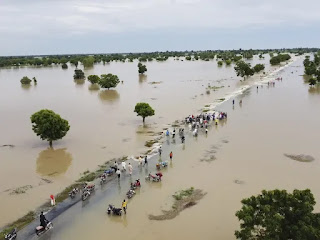
The 2025 state of the climate report, published last week, paints a bleak picture of the state of the Earth and its capacity to support life and human society as we know it [1]
This report by leading climate scientists is stark from the first sentence:
“We are hurtling toward climate chaos. The planet’s vital signs are flashing red. The consequences of human-driven alterations of the climate are no longer future threats but are here now”
“Recent developments … mark the beginning of a grim new chapter for life on Earth”
The report is aimed at “fellow scientists, policymakers, and humanity at large”
But we live in times where experts are undermined and dismissed. Do we listen to the siren calls of global heating deniers and fossil fuel interests or to the consensus of thousands of scientists who have spent their careers analysing global satellite, earth science and weather data and can see the trends? I know who I would believe.
The message is loud and clear. Change direction now. It’s too late to avoid consequences, but not too late to avoid the worst.
The report highlights various climate records which were reached in 2024:
- Global surface temperature
- Population and livestock numbers
- Meat consumption
- Fossil fuel energy consumption
- Atmospheric carbon dioxide
- Global fire-related tree cover loss
- Ocean heat content
- The largest coral bleaching event ever recorded
- Greenland and Antarctic ice mass are at record lows
- Deadly and costly disasters surged
On the positive side
- Combined solar and wind consumption also set a new record but was 31 times lower than fossil fuel energy consumption
- Climate change mitigation strategies are available
- Social tipping points can drive rapid change
But the risks are serious and wide-ranging
- Loss of biodiversity
- Shutdown of the Atlantic meridional overturning circulation (Even with global warming, the UK could freeze to -19C extremes in winter) [2]
- Loss of available freshwater
- Earth on a Hothouse trajectory
- Global temperatures more than 3°C above preindustrial levels by 2100
- Devastating impacts on natural systems and humanity
Implications for Diet and Meat Consumption
There are several primary causes of climate chaos mentioned in the report. All of them need to be addressed. This Piece will focus on livestock farming particularly for beef and lamb consumption (ruminants).
It may seem surprising that a traditional and globally popular food should cause so much damage and contribute to a threat to human civilisation.
The report gives more detail
“Ruminant livestock and per capita meat consumption are at all-time highs, as of 2023”
“Ruminant livestock methane emissions account for roughly half of all agricultural greenhouse gas emissions” [3]
500,000 ruminants are added to the global numbers weekly
Although not mentioned, pig and chicken production is also a cause of climate heating because of the deforestation caused when land is cleared to grow animal feed
One way to deal with this is to change our diets
“Climate change mitigation strategies are available, cost effective, and urgently needed. From forest protection and renewables to plant-rich diets, we can still limit warming if we act boldly and quickly … while offering many benefits related to human health, food security, and biodiversity” [4]
The report then goes on to make an astonishing claim about the magnitude of the benefits gained by moving to plant-rich diets:
The potential reduction in green house gas emissions associated with dietary changes may be on the order of 0.7–8.0 billion tonnes of CO2 equivalent per year by 2050” [5]
20% of annual green house gas emissions reduced by 2050!
The large range of values is given because of uncertainties in the level of future dietary change and how the released land is used. With a global transition to vegan diets and reforestation of freed land then the upper value of 8 GtCO2eq per year could potentially be achieved;
This shows the importance of plant-based diets as a tool to halt climate chaos
Options
To say, “I cannot give up beef” is no longer a serious option
To take up a varied and nutritious plant-based diet is good for the environment, health, for biodiversity and wildlife, and for the animals no longer farmed
That is the option for a healthy planet
References
[1] https://doi.org/10.1093/biosci/biaf149
The 2025 state of the climate report: a planet on the brink
William J Ripple, Christopher Wolf, Michael E Mann, Johan Rockström, Emily Shuckburgh and others, 29th October 2025
[3a] Report, Page 1
[3b] https://openknowledge.fao.org/items/b3f21d6d-bd6d-4e66-b8ca-63ce376560b5
Food and Agriculture Organization of the United Nations. 2023. Pathways towards Lower Emissions: A Global Assessment of the Greenhouse Gas Emissions and Mitigation Options from Live-stock Agrifood Systems.
[4] Report, Key Highlights, Page 2, box 1
[5] Report, Climate change mitigation strategies, page 5
